Direct Digital Microwave Output
High-sample-rate direct digital playback replaces conventional baseband mixing, helping eliminate LO leakage and I/Q imbalance at the source.

Digital Array Measurement-and-Control System for advanced computing, microwave control, synchronized signal acquisition and real-time feedback in complex physical experiments.
*Published system/datasheet figures. Actual rates, frequency coverage and resolution depend on the selected module and configuration.
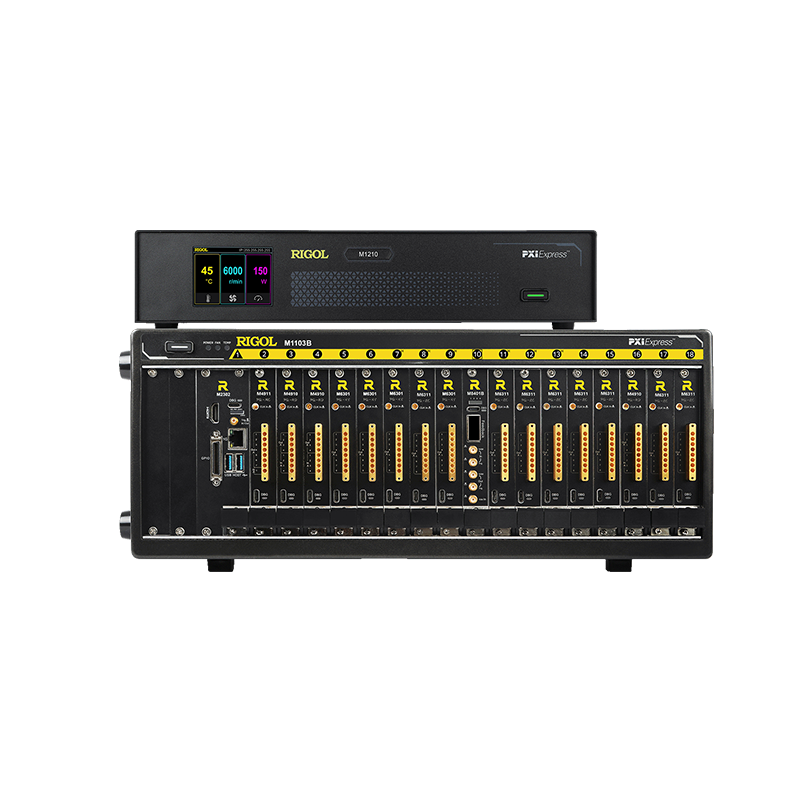
RIGOL SPQ is designed for complex physical experiments and advanced-computing applications. Its modular architecture combines microwave control, readout analysis, fast bias, synchronization and triggering into a configurable measurement-and-control system.
Select the service modules required for the experiment and combine them with the device platform and synchronous trigger modules. The architecture supports staged deployment, system expansion and customized measurement workflows.
Purpose-built digital architecture supports signal quality, channel density, synchronization and low-latency feedback for demanding array experiments.
High-sample-rate direct digital playback replaces conventional baseband mixing, helping eliminate LO leakage and I/Q imbalance at the source.
Direct digital output supports consistent pulse amplitude and precise phase, improving signal purity and long-term stability.
The current SPQ product overview describes more than 500 microwave control channels in a 19-inch, 16U chassis, with channel isolation of at least 65 dBc.
Coordinate multiple systems for large-scale experiments. The published datasheet describes phase drift below ±5 ps across synchronized devices.
Instruction-set-driven FPGA programming supports dynamic measurement and control workflows and fast feedback operations.
A dedicated feedback path enables active-reset waveforms to be issued rapidly after gate operations in supported configurations.
Signal purity and phase stability are critical in experiments involving noise-sensitive computing elements. SPQ is designed to provide a clean, consistent microwave control environment.
RIGOL specifies a phase-noise performance of −142 dBc/Hz at a 100 MHz carrier and 1 kHz offset.
The product page specifies noise spectral density below −160 dBm/Hz, supporting noise-sensitive microwave experiments.
SPQ uses a modular structure so that each functional area can be configured according to the experimental requirements.
The main hardware platform provides the modular chassis and infrastructure for the installed measurement-and-control modules.
Choose functional modules such as microwave control, readout analysis and fast bias according to the experiment.
Coordinate timing, clock and trigger distribution across the measurement-and-control system.
The SPQ architecture supports data exchange between the measurement system and external computing resources through a PXIe-to-PCIe bridge.
Connect the SPQ service boards to a server through PCIe-based communication and supported optical-fibre links.
RIGOL's product overview describes peer-to-peer data exchange, microsecond-level end-to-end latency and bandwidth exceeding 6 GB/s.
SPQ provides an instruction-set-based approach to measurement and control, enabling dynamic FPGA programming and rapid response in supported experiments.
Run the programmed measurement or gate operation.
Capture and process measurement data through the configured readout modules.
Use the dedicated instruction path to respond to the measurement result.
Issue active-reset waveforms in supported control workflows.
SPQ supports complex experimental environments requiring scalable microwave control, acquisition and synchronized measurement.
Microwave control and readout infrastructure for experiments involving noise-sensitive quantum devices.
Build measurement-and-control systems for complex physical computing experiments.
Deploy synchronized measurement channels across multi-device experimental systems.
Generate high-quality microwave pulses with direct digital output architecture.
Integrate experimental measurement hardware with server-based computing resources.
Support demanding laboratory experiments that require low-noise signals and precise synchronization.
Talk to our team about module selection, system architecture, channel requirements, synchronization and application-specific configuration.